
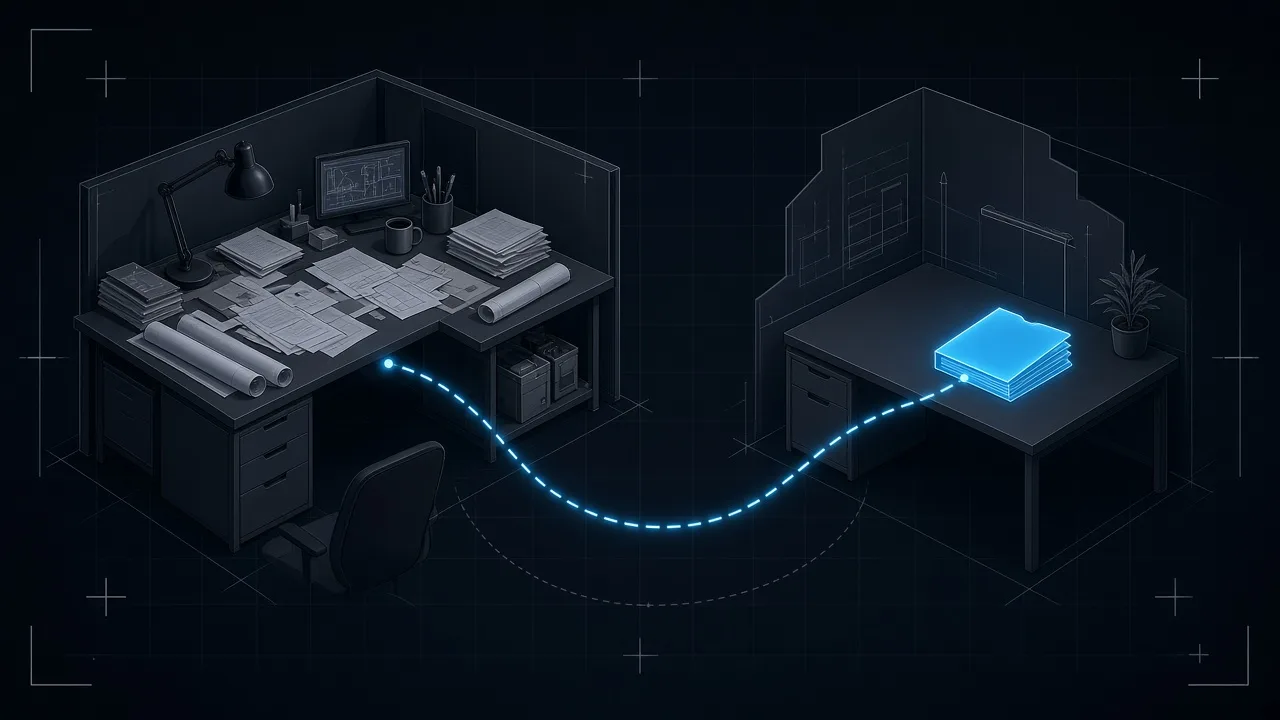
The mess on your desk does not travel with them
You send an engineer to another office with a clean folder. Their own mission. A new desk. They do not inherit the clutter on your table. They come back with a deliverable — a schedule, a diff, a report with evidence. The point is not “more intelligence”: it is new context. In the harness, that is an agent.
If you only have three minutes: agent = new office + mission + deliverable; skill = laminated card that sticks to whoever is already working.
This note is part of the series on the AI harness for civil engineering. It pairs with context compaction: sometimes the fix is another desk, not more paper on this one.
What many people do not know: you can send work off the main thread
There is a main thread: the harness conversation you are already in. That is your desk. Yesterday’s budget is still there, the units argument, the assumption about the frame. It is useful. It also saturates.
And there is something many readers do not know exists: you can dispatch an agent outside that thread. It is not “another message in the same chat.” It is sending someone to another office with a clean folder. A bounded mission. Their own context. When they finish, they come back with the deliverable — table, schedule, diff, log — without having dirtied or saturated the main desk.
Why? Because the main thread is shared working memory. If you paste every mission onto it, the history grows, the model compacts, assumptions mix, and you sign a paragraph born of noise. If you dispatch an agent aside, the mission does not contaminate the context where you are still thinking about the project.
Office analogy: the principal does not shout at the same engineer, at the same table covered in drawings, “now also do the level-3 inventory.” They send them to another room with a clean folder. When they return, the principal still has a usable desk.
First the scene, then the buzzword
Path one: the same chat. You ask for the frame, then the wall, then “now the budget.” The history grows. The model compacts. Units mix. You sign the paragraph because “the agent said so.” There was no agent. There was a saturated conversation.
Path two: you dispatch a bounded task off the main thread. You give it only what it needs — file, level, units, what is forbidden to invent — and a clean place. When it returns, it brings a schedule, a diff, a report with evidence. You review and you sign. If it failed, it failed in its office, not in the pile on your desk.
That second scene deserves the name agent: it changes where the work lives.
What an agent is, in office language
An agent, in practical AEC, is an AI process you assign a bounded mission in a new context: its own instructions, files, tools, and limits. It is not “the model.” The model predicts text. The agent is the mission + the desk + the hands + the rule for when to stop.
Mission
What it must bring back. “List of walls on level 3 with no type, with element id.” Not “help me with the project.”
Clean desk (new context)
It does not drag yesterday’s chat or the units fight from message twelve. It arrives with a clean folder. If it needs a datum, it asks or it reads it with a tool. That new desk is what you gain by dispatching it off the main thread.
Deliverable and return
It comes back. An agent that “keeps thinking” with no clear output is an open tab. The value is in the reviewable deliverable: table, diff, log, list with IDs.
Agent versus skill: the difference that matters
A skill (a packaged ability or procedure) is the office’s laminated card: the standardized instruction anyone applies without hiring another person. It sticks to whoever is already working. It does not open a new head or a new desk.
An agent, by contrast, is sending someone. New office. New folder. New context window — off the main thread when that is needed.
- You need the wall-review procedure to exist for the whole team → skill.
- You need someone to do today’s level-3 review without being contaminated by the budget chat → agent.
If you hire “an agent” when what you wanted was a laminated card, you are paying for another office to print a standard procedure. If you stick on a skill and expect it to “go to another office on its own,” you are left with the same desk and a pretty card.
Why AEC feels this in the stomach
In civil engineering, context is not decoration. It is capacity, unit, code edition, GUID, load combination.
When the same thread mixes yesterday’s frame with today’s wall, the risk is signing a number born of an assumption that no longer applies. Compacting the chat is like sending a junior to summarize the site diary and throwing away the page that said kN. (That is developed in context compaction.)
That is why an agent with a clean folder is not a luxury: it is hygiene. Dispatching off the main thread is not an interface detail: it is not saturating the desk where you are still designing.
Desktop demo — not a client case —: you ask “review IFC” in the same chat after half an hour of renders, and then the same thing in a dispatched task with only the IFC and the units. The difference is not magic: it did not inherit the mess.
For the map of the harness, go back to what an AI harness is. If what you are missing is the card, not another office, continue with how to standardize instructions.
Evaluation and limitations
Treat the notes below as evaluation context, not as a verified calculation or code check.
Distinguish agent (new context, off the thread) from skill (same policy, same desk). If you cannot say where it ran, you do not have evidence.