
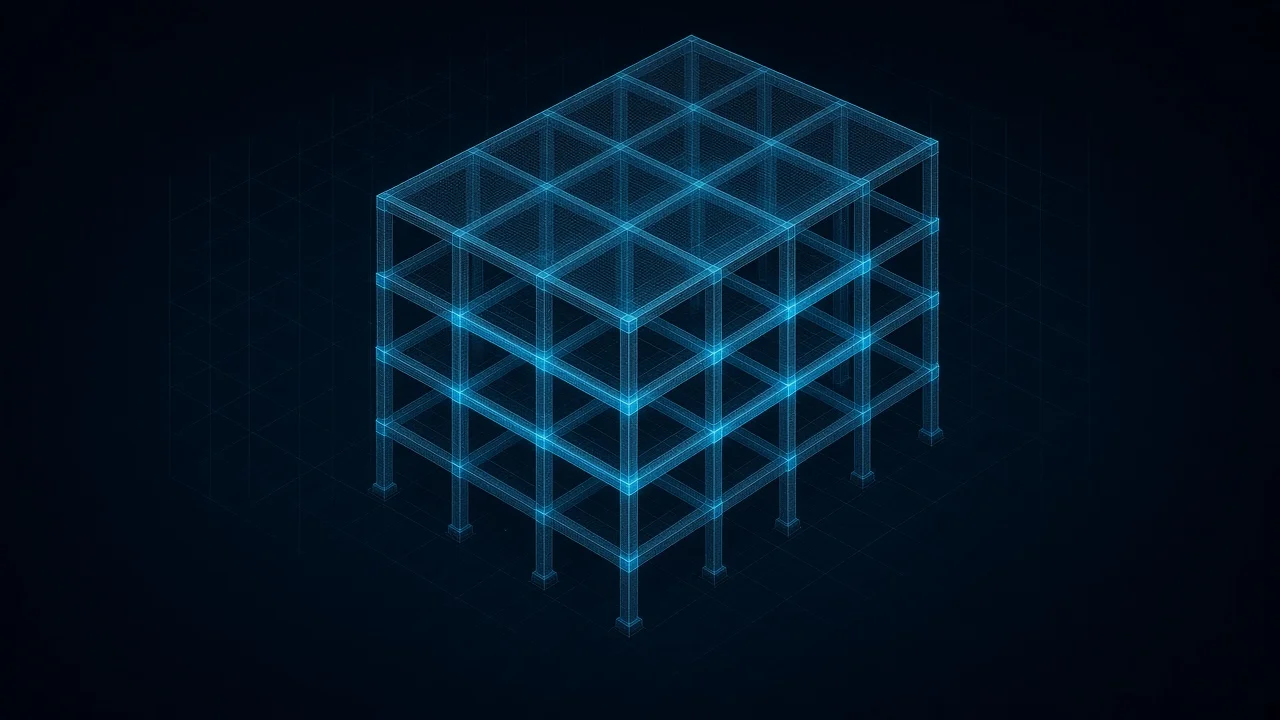
An engineer does not think of a building as a cloud of nodes. They think floors, beams, columns, walls, and diaphragms. ETABS was born to speak that language — and more than half a century of lineage sits behind the window you open today.
What does ETABS mean?
Extended Three-Dimensional Analysis of Building Systems. The name already warns you: this is not a generic FEM package. It is specialized for buildings.
1970: SAP and Edward Wilson
To understand ETABS you have to go through Edward L. Wilson (UC Berkeley) and SAP (Structural Analysis Program, ~1970), an influential family in computational structural analysis. Multi-storey buildings have regularity — floors, diaphragms, frames, walls — that a general-purpose program does not fully exploit. That is where the idea of software made for buildings comes from.
1975: early ETABS at Berkeley, and CSI is founded
Historical earthquake-engineering documentation records an ETABS program around 1975 in the Department of Civil Engineering at UC Berkeley (Wilson, Hollings, Dovey): linear analysis of frame-and-wall buildings under static and seismic loads. The idea was already today’s idea: take advantage of the particular structure of a building.
That same year Ashraf Habibullah founds Computers and Structures, Inc. (CSI) in the Berkeley/Oakland area. CSI would end up behind ETABS, SAP2000, SAFE, CSiBridge, and PERFORM-3D, in an ecosystem marked by Berkeley’s seismic research.
TABS77, Cray, and the PC
CSI’s official timeline records TABS77 (1977) in the commercial lineage. In 1979, ETABS (and ETAISC) for Cray supercomputers: what runs on a laptop today once asked for a machine from another world. In 1984, ETABS84 arrives on the IBM PC — serious building analysis on a personal computer, in the same era AutoCAD was bringing drafting to the desktop.
A program that speaks “building”
A general solver thinks node, element, degree of freedom. ETABS adds higher-level concepts: Story, Beam, Column, Wall, Floor, Diaphragm, Pier, Spandrel. The model looks like the structural engineer’s language, not only an FEM mesh.
Stories organize geometry, masses, loads, displacements, and storey drifts: natural results for seismic design.
Earthquakes, FNA, and the move into design
ETABS grew tied to earthquake engineering: modal analysis, response spectra, time history, P-Delta, pushover, and nonlinear work. In 1986 CSI places the introduction of the FNA method (Fast Nonlinear Analysis) in ETABS: its own numerical methods, not just “a pretty window around a solver.”
Over time it moved from internal forces to a platform of modelling → analysis → design (concrete, steel, composites) → review → reports, with international codes. The modern engine of CSI products is SAPFire.
What you can do with ETABS
Concrete and steel buildings
Model beams, columns, slabs, walls, and diaphragms; frames, braces, and composites. Gravity, earthquake, and wind in the same model, organized by storeys.
Structural walls
Organize results with piers and spandrels: read shell meshes as higher-level structural pieces, not as a sea of elements.
Seismic analysis
Equivalent static, response spectrum, time history, pushover — according to the code and the objective. Storey drifts, modes, seismic masses: the daily work of the office.
Tall buildings and P-Delta
Second-order effects (P·Δ) when gravity load acts on the displaced structure. CSI has cited use of its software on large-scale projects (e.g. Taipei 101, One World Trade Center); the point is not the skyscraper’s name, but that the program is built for that organizational scale.
Performance-based design
When checking strength is not enough: damage, deformation, hinges, performance level. For still more specialized studies, CSI also develops PERFORM-3D.
BIM exchange and automation
Links or compatibility with Revit, Tekla, IFC, DWG/DXF. And an API (C#, C++, VBA, Python, MATLAB, and others) to build a model → run analysis → pull results → optimize, without living only inside the program window.
Short contrasts
ETABS vs SAP2000
ETABS: specialized for buildings. SAP2000: more general (industrial, towers, stadiums, special systems). Using ETABS for everything throws away the advantage of having distinct tools.
ETABS vs CalculiX
ETABS: the whole building + a design code. CalculiX: detailed FEM, local stresses, contact. They can live in different phases of the same project.
What ETABS does not decide for you
Short timeline
- ~1970 — SAP (Edward Wilson).
- 1975 — early ETABS at UC Berkeley; Habibullah founds CSI.
- 1977 — TABS77.
- 1979 — ETABS on Cray.
- 1984 — ETABS84 on the IBM PC.
- 1986 — FNA in ETABS.
- 1990s–2010s — modern graphical interface, integrated design, PBD, BIM, API.
- 2025–2026 — ETABS v23 line (per CSI).
Conclusion
ETABS is older than the screen you open. It connects Berkeley, FEM, earthquake engineering, the mainframe, the PC, code-based design, BIM, and APIs. Its strength has not changed: it does not try to be the solver of everything; it tries to understand how buildings work — so you think in stories and drifts, not only in matrices.
References
- Computers and Structures, Inc. About / History.
- Computers and Structures, Inc. ETABS.
- CSI. ETABS Enhancements / v23.
- Wilson, E. L.; Dovey, H. H.; Habibullah, A. Historical CTABS80 / TABS documentation (USACE/WES; DTIC).
- Historical UC Berkeley / NISEE documentation on Extended Three-Dimensional Analysis of Building Systems (ETABS, ~1975).
Evaluation and limitations
Treat the notes below as evaluation context, not as a verified calculation or code check.
Treat it as a building program: stories, walls, earthquakes, and design. Model fidelity — diaphragms, masses, supports, and modes — remains the engineer’s responsibility.